

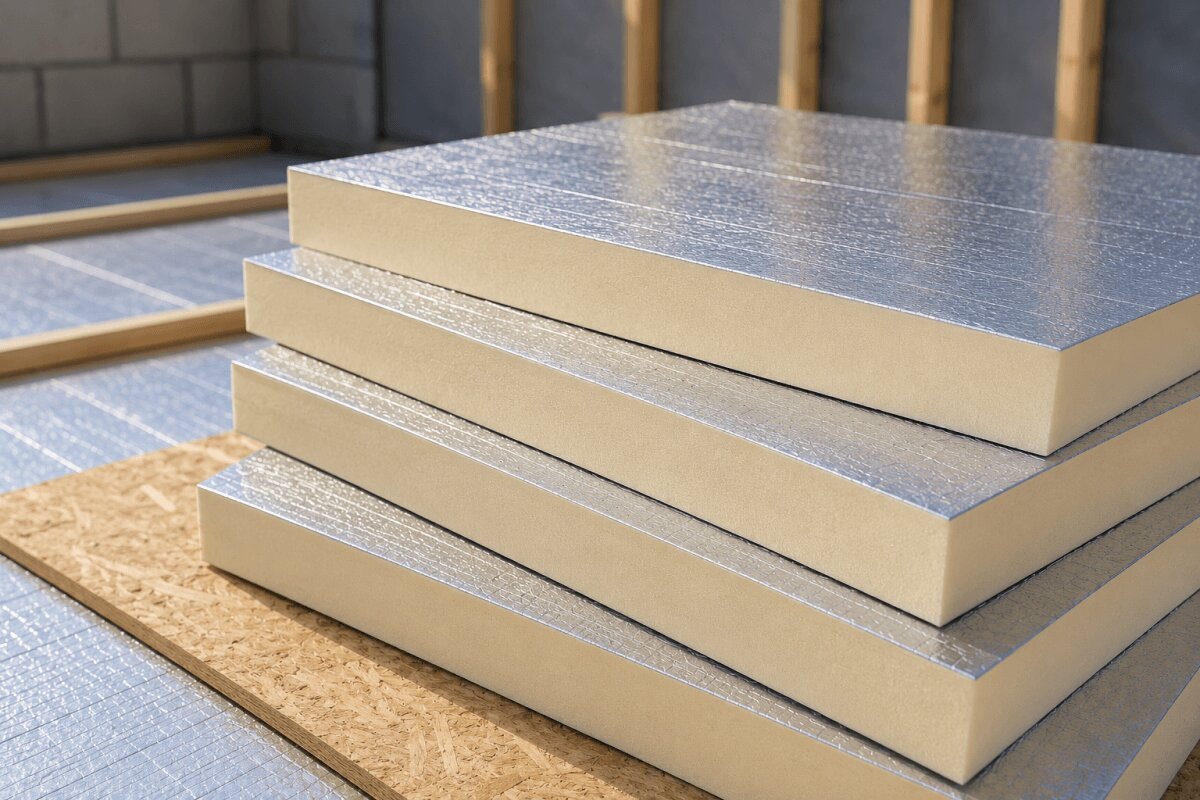
What Are PIR Insulation Boards and Where Are They Used?
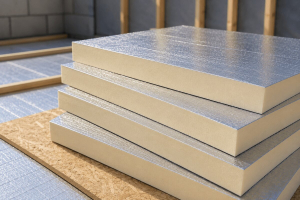
PIR insulation boards are rigid foam panels used to reduce heat loss in buildings. They are one of the most thermally efficient insulation materials available, which is why they are such a popular choice across both new builds and retrofit projects. PIR boards are used in floors, walls, and roofs, across domestic homes, commercial buildings, and agricultural or industrial structures. Their low thermal conductivity means you get strong performance without needing excessive thickness.
What Is PIR Insulation Made Of?
PIR stands for polyisocyanurate, a rigid foam developed as an improvement on polyurethane (PUR) insulation.
During manufacture, a liquid foam mixture is laid onto a facing material, where a blowing agent triggers a chemical reaction. The foam expands and rises to meet the opposing face. From there, the result is a closed-cell structure that traps gas inside, and the gas is what gives PIR its thermal qualities.
Most PIR boards are faced on both sides with a composite aluminium foil, which also acts as a vapour barrier when boards are correctly installed, and joints are taped. Other facings exist for specific applications, such as glass tissue for flat roof membrane compatibility.
What Is PIR Insulation Board Used For?
PIR turns up across most parts of the building envelope, and here’s where it’s most commonly featured:
Floors
PIR boards are commonly used in ground floors, either above or below a concrete slab, and can be cut to fit between suspended timber floor joists in older properties.
Cavity Walls
The most common application is probably cavity walls. PIR boards slot into masonry cavity walls as either a partial fill or a full fill solution, in a smaller 1200mm x 450mm format sized to suit standard wall tie spacings.
Pitched Roof
Boards can be fitted above the rafters, below them, or in a combined approach, a popular choice for loft conversions where preserving headroom matters.
Flat Roofs
In warm flat roof construction, PIR boards sit above the structural deck and beneath the waterproofing membrane, with some boards having specialist facings for direct membrane bonding.
Timber Frame Walls
PIR can be used as a continuous layer over timber frame panels or cut to fit between the studs, depending on the airtightness and vapour strategy for the build.
How Long Does a PIR Board Last?
When correctly specified, installed, and protected within the building fabric, PIR insulation can last for the full design life of the building, in many cases 60 years or more.
PIR foam doesn't rot and isn't a food source for vermin. That said, it's not indestructible. PIR shouldn't be left in prolonged contact with water, as sustained exposure can damage the bond between the facing and the foam, affecting thermal performance. Store boards under cover on site and get them in as soon as you can. For third-party confirmation of a specific product's service life, the relevant BBA certificate is the place to look.
What Makes PIR a Popular Choice?
The short answer is performance per millimetre. With a typical lambda value of around 0.022 W/mK, PIR outperforms mineral wool and EPS, meaning you can hit the same U-value with a thinner board. In a narrow cavity, a tight loft, or a ground floor where raising the finished level isn't an option, that difference matters.
It's also lightweight for its size, large format boards cover ground quickly with fewer joints, and the foil facing adds vapour resistance as well as a small additional thermal benefit where it faces an air gap.
An Important Reminder About Installation
PIR is only as effective as the installation behind it. Boards need to sit tightly with no gaps around the perimeter or between boards, particularly when cut to fit between rafters or joists. Any gaps give warm air a route around the insulation, reducing performance and creating a condensation risk.
For cavity walls, the blockwork needs to be reasonably flat before the boards go in as PIR won't flex around mortar snots. Tape the board joints where vapour control is part of the design. If you're unsure which board or thickness you need, it's worth a conversation before you order.
PIR Insulation Supply in the West Midlands
Emerys has been supplying building materials across the West Midlands for many years. We stock PIR insulation boards in a range of thicknesses for floors, walls, and roofs, and our team knows the products well enough to point you in the right direction. Get in touch for advice.